How to Grow Asparagus
Plant dormant one-year-old asparagus crowns in early spring, 12 to 18 inches apart in a trench 6 to 8 inches deep, cover them with 2 inches of soil, and fill the trench gradually as the shoots grow. Skip the harvest the first year, then start light in the second or third year, depending on the source, and build up to 8 weeks or more. A well-kept bed produces for 10 to 15 years or longer.

Your dates for asparagus
Set your ZIP code at the top of the page and we will work out when to plant asparagus where you live, from the frost records of the nearest NOAA weather station. Your ZIP code is remembered on this device only.
Asparagus at a glance
- Botanical name
- Asparagus officinalis
- Light
- full sun (at least 6 hours; 8-10 hours preferred)
- Frost tolerance
- Hardy: takes a hard frost
- Hardiness zones
- 2-9
- Soil temperature to plant
- At least 50°F (best 60–85°F)
- Germination
- 10–24 days
- Planting depth
- 6 inches
- Spacing
- 12–18 inches apart, rows 48–60 inches apart
When to plant asparagus
| Zone | Plant out |
|---|---|
| Zone 2a | May 21 to Jul 2 |
| Zone 3a | May 15 to Jun 26 |
| Zone 3b | May 11 to Jun 22 |
| Zone 4a | May 7 to Jun 18 |
| Zone 4b | May 2 to Jun 13 |
| Zone 5a | Apr 28 to Jun 9 |
| Zone 5b | Apr 26 to Jun 7 |
| Zone 6a | Apr 20 to Jun 1 |
| Zone 6b | Apr 13 to May 25 |
| Zone 7a | Apr 4 to May 16 |
| Zone 7b | Mar 25 to May 6 |
| Zone 8a | Mar 7 to Apr 18 |
| Zone 8b | Feb 18 to Apr 1 |
| Zone 9a | Jan 19 to Mar 2 |
| Zone 9b | Dec 20 to Jan 31 |
Spring dates before the last frost assume the soil has thawed and is dry enough to work. After a late or wet spring, wait for that even if the date has passed.
Plan for a 15-year planting
Asparagus is a long-lived perennial. Utah State expects a bed to produce for 10 to 15 years and Maryland for 12 to 15 or more. Texas A&M says a crown can last 15 to 25 years in a suitable climate, while Clemson sees seven to eight highly productive years before a gradual decline. Every year depends on decisions you make before planting, because you can’t easily dig in organic matter, fix drainage or correct pH under an established bed.
Pick the site carefully:
- Full sun. At least 6 hours of direct light, and 8 to 10 is better.
- Good drainage. Crown and root rots are the classic way beds fail. Deep, loose, sandy or loamy soil is ideal. Texas A&M treats yellow nutsedge as a sign of poor drainage and a site to avoid.
- Ground never used for asparagus. Clemson recommends a fresh site to avoid Phytophthora crown and root rot.
- The edge of the garden. Ferns grow 3 to 5 feet tall and will shade neighboring crops. Clemson puts the bed along one side of the garden, and Texas A&M suggests a garden edge or fence line.
Kill perennial weeds the year before planting. Utah State is emphatic about this, and Texas A&M singles out johnsongrass, bermudagrass and nutsedge. Once crowns are in you can no longer dig the bed over, so this is your one chance to clear them.
Prepare the soil
Test the soil first. Recommended pH varies a little by source: Clemson aims for 6.0 to 6.5, and Texas A&M for 6.5 to 7.5, warning that asparagus does poorly below 6.0. If lime is needed, Clemson applies it at least three months before planting. Fall bed preparation for a spring planting gives you that time.
Work in plenty of compost. Clemson’s rate is about 20 percent of the soil volume, and Texas A&M spreads 3 inches in late fall and digs it in 10 to 12 inches deep. In heavy clay, Clemson recommends double digging, loosening the subsoil another 10 to 12 inches below the top foot.
Phosphorus needs special care. It moves very slowly through soil, and the crowns will end up 6 to 8 inches down, so put it in the bottom of the trench at planting. Utah State uses ½ pound of 11-52-0 per 100 square feet of furrow. Clemson uses 5 pounds of 5-10-10 per 100 feet of row in the trench, covered with at least 2 inches of soil before setting the crowns. Texas A&M bands superphosphate in the furrow.
Choose all-male varieties
Asparagus plants are either male or female. Females put energy into red berries, so they yield less, and their seeds sprout into weedy seedlings. All-male hybrids outyield the old mixed cultivars about 3 to 1, according to Clemson, and are typically around 93 percent male. Maryland recommends all-male hybrids for both yield and disease resistance.
Extension recommendations by region:
- Utah and the Intermountain West: Utah State recommends ‘Jersey Giant’ and ‘Jersey Knight’, both all-male with good disease resistance. It suggests ‘UC 157’ for warmer parts of Utah and ‘Purple Passion’ for purple spears. It no longer recommends ‘Mary Washington’.
- South Carolina and the Southeast: Clemson’s list includes ‘Jersey King’ (vigorous, large spears, good in warm Southern climates), ‘Jersey Giant’ (adapts well to the South), ‘Jersey Supreme’ (warm and cold climates), ‘Jersey Knight’ (high spear quality, does well in clay) and ‘Jersey Gem’ (best in cooler climates).
- Texas: Texas A&M names ‘Jersey Giant’, ‘Jersey Knight’ and ‘Jersey Supreme’ as more productive and disease resistant than the female ‘Washington’ types.
On the older ‘Mary Washington’, sources disagree. NC State still lists it as a heavy yielder, and Texas A&M includes it among varieties that outproduce standard cultivars. Utah State and Clemson point gardeners to all-male hybrids instead. ‘Purple Passion’ crowns may be about half female, and Clemson notes it may need an extra year before harvest.
Crowns or seed
Most gardeners start with one-year-old crowns. Clemson favors two-year-old crowns, which are larger and give more spears in the first harvest years. Look for plump, firm crowns with plenty of roots: Utah State wants 8 to 10 large roots and a healthy bud cluster, and Clemson 15 to 20 storage roots. Maryland rejects crowns that are shriveled, dry and brown, or soggy and black.
Plant crowns soon after they arrive. If you must hold them, Maryland keeps the roots barely moist and cool, or heels them into a shaded trench of moist soil. Don’t let them dry out or freeze.
Seed adds about a year before the first harvest. It germinates best in warm soil: Oregon State measured about 24 days to emergence at 59°F and 10 days at 77°F. At 50°F it took 53 days, and colder soil gave little or no germination. Utah State sows seed indoors in January for transplanting in April.
When to plant
Plant crowns in early spring while they are still dormant. The dates for your zone above run from about six weeks before the last frost up to the frost date. Clemson warns that crowns planted too late may start sprouting before they go in, which can injure the developing buds. See when to plant asparagus for regional timing, including winter planting in the low desert.
How to plant
- Dig the trench. Clemson and Maryland use a trench 6 to 8 inches deep and 12 to 18 inches wide. Utah State uses 8 inches, and Maryland notes the traditional depth is 12 inches. Texas A&M adjusts for soil: 6 to 12 inches in loose soil, 4 to 6 in heavy soil. Space trenches 4 to 5 feet apart.
- Fertilize the bottom with phosphorus as described above, and mix some compost-enriched soil back in.
- Make a low ridge of soil down the center of the trench.
- Set the crowns on the ridge with roots spread down both sides and buds up. Space them 12 inches apart (Utah State), 12 to 14 inches (Texas A&M) or 15 to 18 inches (Maryland, Clemson). Texas A&M notes that close spacing gives smaller spears, and wider spacing larger spears but less total yield. Sort crowns by size and plant similar sizes together for even spears.
- Cover with 2 inches of soil and water well.
- Fill the trench gradually. As shoots grow, add soil around them without burying the ferns. Clemson adds about 2 inches every two to three weeks, and Utah State 2 inches every other month. The trench should be level with the surrounding soil by the end of the first season.
Maryland also describes a wide bed of three rows, with plants 18 inches apart in every direction. In windy areas, run the rows parallel to the prevailing wind so the ferns support each other.
The first two years: grow ferns, not spears
Don’t harvest in the year you plant. Every spear that becomes a fern feeds the crown, and a big crown is what gives a long, heavy harvest later. Clemson won’t start harvesting until the previous year’s ferns were vigorous, bushy and shoulder-high.
Water is critical early. Clemson warns that drought in the first two months after planting can lower yields for the life of the bed. Water to moisten the soil at least 6 inches deep, since frequent light sprinkling keeps roots shallow. Utah State gives 1 to 2 inches every other week during the first two years, then every three weeks from year three, wetting the soil 3 to 4 feet down. Asparagus roots run deep. Texas A&M notes they can reach 10 feet in sandy soil.
Keep the young bed weeded. Asparagus is a poor competitor, and Texas A&M suggests 4 to 6 inches of organic mulch to smother weeds. Clemson keeps 2 to 3 inches of mulch on the bed year-round.
Care of an established bed
Feeding. Feed twice a year: once in early spring before spears emerge, and again after the harvest ends to fuel fern growth. Clemson uses 5 pounds of 5-10-10 per 100 feet of row in early spring and 1½ pounds of calcium nitrate after harvest. Utah State applies about 1 pound of 16-16-8 per 100 square feet in early June or after harvest. Texas A&M uses 2 pounds of 10-20-10 per 20 feet of row in late January or early February, then 1 to 2 pounds of nitrogen fertilizer after the last harvest. A yearly topdressing of compost helps too.
Weeding. Weed in early spring before spears appear so you don’t snap them off, and pull weeds by hand during harvest instead of hoeing. Utah State warns against tilling asparagus beds because it damages the crowns. Texas A&M allows only shallow tilling, 1 to 2 inches deep, when fertilizing.
Summer. Next spring’s spears form in late summer, and Utah State says stress in July and August shows up as thin spears the following year. Keep the ferns healthy and watered all summer, and control beetles. Stakes and string keep tall ferns tidy.
Fall and winter. Sources differ on when to cut the ferns. Maryland cuts them to 2-inch stubs once frost yellows them, before female plants drop their berries. Clemson leaves the brown ferns until late winter so nutrients can move from the foliage back to the crowns. Texas A&M cuts them after the first hard freeze and composts or burns them to destroy overwintering beetle eggs and disease. All agree the old stems must go before spears emerge. Maryland follows with 4 to 6 inches of mulch.
Harvesting
Harvest begins in the second or third spring and stays light at first:
- First harvest year: about 3 to 4 weeks
- Next year: about 6 weeks (Utah State)
- Mature bed, year 4 or 5 on: up to 8 weeks per Utah State, or 8 to 10 weeks per Maryland
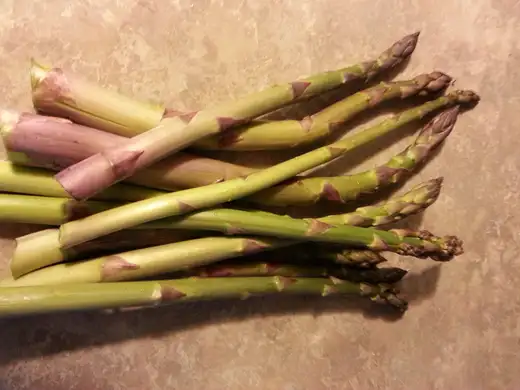
Pick spears when they are 6 to 9 inches tall with tight tips. Snap them off at the soil line or cut just below it, being careful not to cut so deep that you damage buds on the crown. Pick daily or at least every other day, because taller spears turn tough and fibrous at the base. Stop when most new spears are thinner than a pencil, about ⅜ inch per Texas A&M, and let the rest grow into ferns. Utah State notes that in most of Utah the harvest ends by early to mid-June.
Refrigerate spears right away. Utah State says they keep 3 to 5 days at about 35°F and high humidity. Texas A&M allows up to 3 weeks in plastic bags in the refrigerator, but quality drops quickly after cutting, so use them soon.
White asparagus is the same plant grown in the dark. Mound soil or mulch over the row, or cover it with black plastic, and cut spears just as the tips appear.
Regional notes
Cold North (zones 2 to 6). Asparagus is hardy to zone 2, and cold winters give it the dormancy it needs. Mulch after cutting the ferns. Maryland suggests pulling the mulch off half the bed in spring so that half warms and sprouts earlier, spreading out the harvest.
Humid South. Clemson plants crowns from late winter into early spring in South Carolina and recommends Jersey hybrids suited to warm climates. It links crown rot and poor yields to heavy, poorly prepared soil, so double dig clay and keep the bed well drained. Use drip irrigation to cut down on rust.
Arid West. Utah State waters established beds deeply about every three weeks. Texas A&M says the crop suits the cooler parts of North and West Texas best, and that asparagus tolerates high-pH soils.
Warm-winter areas (zones 9 to 10). Asparagus needs a dormant period to send up good spears, and where winters are mild it often doesn’t get one. In the Phoenix area, the University of Arizona plants crowns from November into early February. In South Texas, the ferns may not freeze back, so Texas A&M cuts them in late November when they yellow. UF/IFAS warns that Florida spears tend to be smaller and more spindly than those grown farther north.
Problems and fixes
- Asparagus beetle: adults chew emerging spears and larvae strip the ferns. Hand-pick, clear fern debris in winter where adults overwinter, and use labeled insecticides if needed.
- Asparagus aphid: stunts ferns and spreads viruses. Use insecticidal soap.
- Fusarium and Phytophthora crown and root rot: yellowing fern tips, dying stems and thin spears. Plant in well-drained soil on a site never used for asparagus, and reduce stress from overwatering, drought, overcutting, insects and weeds.
- Rust: orange to brown pustules on the ferns. Choose resistant varieties and use drip irrigation instead of overhead watering.
- Weak, spindly bed: harvesting too soon or for too long. Clemson warns that overcut crowns may never recover. Follow the harvest schedule and only harvest after a year of strong fern growth.
- Spears broken off while weeding: weed before spears emerge, then pull weeds by hand and rely on mulch.
No extension source recommends companion plants for asparagus. Pairings you read about elsewhere are garden tradition, not tested results.
Questions
How long does it take asparagus to produce?
From one-year-old crowns, Maryland Extension allows a light 3- to 4-week harvest in the second season, Utah State waits until the third, and Clemson until the third or fourth. Seed-grown plants need about one more year.
Why are my asparagus spears so thin?
Usually the plants were stressed last summer, when next year's spears were forming, or they were harvested too hard, too young or too long. Healthy ferns, steady water and stopping the harvest when spears get pencil-thin all help.
Should I buy male asparagus plants?
Yes. All-male hybrids such as the Jersey series spend no energy on seed. Clemson reports they outyield older mixed cultivars about 3 to 1, and they don't drop seedlings into the bed.
When should I cut down asparagus ferns?
After frost turns them yellow or brown. Maryland cuts them to 2-inch stubs in fall, while Clemson waits until late winter so nutrients can move from the ferns back to the crowns. Either way, finish before new spears emerge.
Can asparagus grow in Florida or South Texas?
Only marginally. Asparagus needs a dormant period. UF/IFAS says Florida spears tend to be thin and spindly, and Texas A&M says asparagus produces poorly where winters are mild and summers long and hot.
How many asparagus plants do I need?
Texas A&M suggests about 20 crowns, a 20-foot row or 100 square feet of bed, for a family of four. Utah State says 25 plants is enough for fresh eating plus some to preserve.
Sources
- Easy Gardening: Asparagus (EHT-066) · Texas A&M AgriLife Extension Service
- How to Grow Asparagus in Your Garden · Utah State University Extension
- Growing Asparagus in a Home Garden · University of Maryland Extension
- Asparagus (HGIC) · Clemson Cooperative Extension Home & Garden Information Center
- Asparagus officinalis (Plant Toolbox) · NC State Extension
- Planting the Garden · University of Vermont Extension
- Rhode Island Planting Calendar for Fruits and Vegetables · University of Rhode Island Cooperative Extension
- Soil temperature conditions for vegetable seed germination · Oregon State University Extension Service
- Asparagus · University of Florida IFAS Gardening Solutions
- Vegetable Planting Calendar for Maricopa County (AZ1005) · University of Arizona Cooperative Extension