How to Care for an Arrowhead Plant
Arrowhead plant grows best in medium to bright indirect light, with potting mix allowed to dry slightly between waterings and temperatures of 65 to 75°F. Feed it monthly at reduced strength in spring and summer, cut back climbing stems to keep the bushy arrowhead-leaf form, and keep it away from pets, since all parts are toxic.
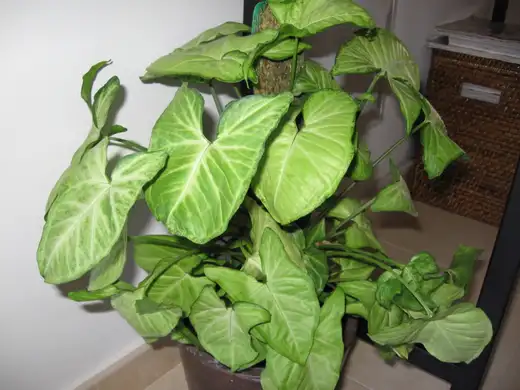

Arrowhead Plants at a glance
- Botanical name
- Syngonium podophyllum
- Light
- medium to bright indirect light; tolerates low light (variegation fades); direct sun burns or bleaches leaves
- Hardiness zones
- 10-12
- Containers
- Yes
Arrowhead plant (Syngonium podophyllum), also sold as arrowhead vine or nephthytis, is a climbing aroid from Mexico, Central America and South America. The plants sold as houseplants are almost always young, bushy plants with arrow-shaped leaves, often patterned with white, silver or pink. Left alone, the plant changes as it matures: stems lengthen and start to climb, and the leaves become lobed and finally split into 5 to 11 leaflets. Much of growing it well is deciding which form you want.
Light
Give it medium to bright indirect light. Clemson Extension suggests an east window or a spot a few feet back from a west window. Clemson adds that a north window also works. NC State warns that direct sun burns or bleaches the foliage.
Light decides how well the variegation holds. Clemson says the patterned types need the brighter end of the range, because in low light they revert to plain green. If new leaves are coming in greener than the old ones, move the plant closer to the window.
Watering
Let the potting mix dry slightly between waterings. Clemson gives that rule, and University of Illinois Extension describes the goal as keeping the soil just barely moist. In practice, push a finger into the mix and water when the top feels dry, then water until it drains from the bottom and empty the saucer.
Clemson reports stem rot on this plant and NC State reports soft rot. Soil that stays soggy is the condition to avoid, so water less often in fall and winter, when it grows slowly and feeding has stopped.
Potting mix and pot
Use a light, airy mix. Clemson recommends equal parts peat moss or coir, vermiculite and perlite, while Illinois says regular potting soil is fine. Any pot needs a drainage hole. Young plants stay compact enough for a pot or hanging basket.
Temperature and humidity
Clemson says it prefers 65 to 75°F and humidity of 50% or higher, but tolerates lower humidity. Sources differ on how much it cares: NC State describes the ideal spot as warm and humid, while Illinois says it grows best in low humidity. Average household conditions suit it, so there is no need for a humidifier unless your air is very dry.
Feeding
Clemson recommends a balanced fertilizer, such as 20-20-20 or 10-10-10, at reduced strength once a month in spring and summer. It is not a heavy feeder. Stop feeding in fall and winter. Clemson advises feeding even less often if you want to keep it in its compact juvenile form or it is growing in low light.
Pruning and training
Decide early whether you want a bushy pot plant or a climber.
To keep the bushy arrowhead form, NC State says to cut off the climbing stems as they begin to develop. Clemson adds that a plant you want to keep juvenile should not be fertilized often. The trimmings can be rooted.
To let it climb, give older plants a moss pole, trellis or bamboo stake, as Clemson suggests, and Illinois recommends a pole or totem for support. Dwarf varieties stay under 2 feet, while standard types can reach 3 to 6 feet tall, according to Clemson.
Repotting
NC State says repotting every few years, and trimming the root system when you do, keeps the plant a manageable size. Do it in spring, as the growing season begins.
Propagation
Stem cuttings are the standard method; Illinois Extension recommends them, and NC State also lists layering and division. UF/IFAS notes it sprouts easily from cuttings, which is also the problem outdoors. Never throw unwanted cuttings or old plants outdoors: UF/IFAS says it has spread in Florida mainly by escaping from gardens and discarded plant material.
Pests and problems
- Leaves turning plain green: not enough light. Move it brighter.
- Burned or bleached patches: direct sun. Move it back from the window.
- Aphids, mealybugs, spider mites: the pests Clemson and NC State list. Inspect leaf undersides and stems and treat early.
- Bacterial leaf spot and bacterial blight: Clemson lists both and NC State lists leaf spot; neither gives specific treatments. Remove badly spotted leaves.
- Stem rot or soft rot at the base: usually soil kept too wet. Let it dry slightly between waterings and check that the pot drains.
- Leggy plant with long stems and changed leaves: normal maturing. Cut back the climbing stems or give them a pole.
Pets and toxicity
Arrowhead plant is toxic. The ASPCA lists it as toxic to dogs, cats and horses because of insoluble calcium oxalate crystals, which cause irritation, pain and swelling of the mouth, tongue and lips, heavy drooling, vomiting and difficulty swallowing. UF/IFAS adds that the sap irritates skin, mouth and eyes, and NC State notes it can cause contact dermatitis, so wear gloves when pruning and wash your hands afterward.
Outdoors, and why not in Florida
NC State rates it hardy in zones 10 through 12 and notes it can be grown as an annual in containers in bright but shady spots. Keep it in a pot.
In Florida, do not plant it in the ground. The UF/IFAS assessment found arrowhead vine to be an invasive threat, the Florida Invasive Species Council lists it as a Category I invasive, and UF/IFAS does not recommend planting it. It was first collected from a Florida natural area in 1966, and it now climbs and weighs down trees and smothers native ground plants; one study found it suppressed native ferns in South Florida. In other frost-free areas, keep it in containers and never dump plant material outdoors.
Questions
Why is my arrowhead plant losing its variegation?
It needs more light. Clemson Extension says variegated types revert to plain green in low light; move it to bright, indirect light and new leaves should show more color.
Why are my arrowhead plant's leaves changing shape?
The plant is maturing. Young plants have arrowhead-shaped leaves, while older climbing stems produce lobed leaves and eventually leaves split into 5 to 11 leaflets. Cutting back the climbing stems keeps the juvenile form.
Is arrowhead plant toxic to cats and dogs?
Yes. The ASPCA lists it as toxic to dogs, cats and horses. Its calcium oxalate crystals cause mouth pain and swelling, drooling, vomiting and trouble swallowing, and the sap irritates skin and eyes.
How often should I water an arrowhead plant?
Water when the mix has dried slightly at the surface, rather than on a schedule. Clemson says to let it dry slightly between waterings, and Illinois Extension says to keep it barely moist.
Can I plant arrowhead vine outside in Florida?
No. UF/IFAS has found it to be an invasive threat, the Florida Invasive Species Council lists it as Category I, and UF/IFAS does not recommend planting it anywhere in the state.
Sources
- Syngonium podophyllum (Arrowhead Plant) · North Carolina Extension Gardener Plant Toolbox, NC State University
- Arrowhead Vine (Syngonium spp.) Indoor Care, Growing Tips & Plant Guide (HGIC 1573) · Clemson Cooperative Extension, Home & Garden Information Center
- Nephthytis · University of Illinois Extension
- Syngonium podophyllum (Arrowhead vine) - Plant Directory · UF/IFAS Center for Aquatic and Invasive Plants
- Arrow-Head Vine - Toxic and Non-Toxic Plants · ASPCA Animal Poison Control Center