How to Care for an Anthurium
Give an anthurium bright, indirect light, water thoroughly once the top inch of mix is dry, and keep it between 65 and 80°F with high humidity. Pot it in a coarse, fast-draining mix of peat, pine bark and perlite, since it grows on trees in the wild. Cared for this way, it can bloom several times a year, with each colorful spathe lasting weeks.
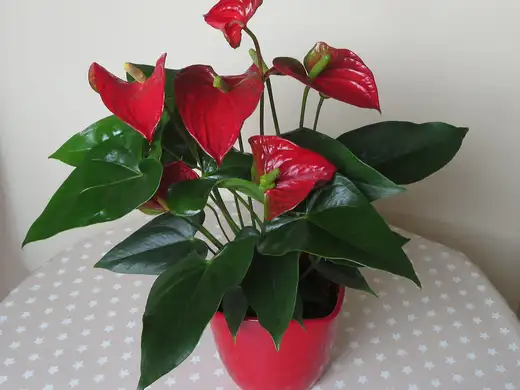

Anthuriums at a glance
- Botanical name
- Anthurium andraeanum
- Light
- bright, indirect light indoors; direct sun can scorch the leaves
- Hardiness zones
- 11
- Spacing
- 18–24 inches apart
- Containers
- Yes
When to repot and propagate anthuriums
The anthurium sold as a houseplant is usually Anthurium andraeanum, the flamingo flower. The glossy red, pink, white or green “flower” is a spathe, a modified leaf; the true flowers are tiny and packed on the tail-like spadix in the center. Indoors it grows about 1 to 1.5 feet tall, NC State says.
Light
Light controls flowering. Clemson recommends bright but indirect light for the most flowers, and NC State lists insufficient light as a main cause of poor blooming. A spot near an east window, or set back from a south or west window, works well.
Keep it out of direct sun, which can scorch the leaves. UF/IFAS notes a split worth knowing: outdoors in South Florida anthuriums do best in shade, but as houseplants they need bright indirect light to thrive.
Watering
Anthuriums need regular water but not wet roots. NC State’s rule is to water when the top inch of soil feels dry. Clemson says to water thoroughly and then let the mix dry slightly before the next watering.
Water until it runs from the drainage holes and empty the saucer. NC State lists root rot from overwatering as a problem, and it lists overwatering and poor drainage as causes of yellow leaves too.
Potting mix and pot
In its native Colombia and Ecuador, A. andraeanum grows as an epiphyte, rooted on trees rather than in the ground. Its roots need air, so ordinary dense potting soil is a poor choice. Clemson recommends a soilless mix of peat moss, pine bark and perlite. Use a pot with drainage holes, and let the roots fill it before moving up a size.
Temperature and humidity
Keep anthuriums between 65 and 80°F, NC State advises, and protect them from cold drafts and sudden temperature swings. Keep them away from winter windows, exterior doors and heating or air-conditioning vents.
Humidity matters more for anthurium than for most houseplants. NC State gives 60 to 80 percent as ideal. UF/IFAS says that below about 50 percent the leaves lose their shine and may die back. To raise humidity:
- Set the pot on a tray of moist gravel, with the pot above the waterline. Both UF/IFAS sources recommend this.
- UF/IFAS also suggests spraying the foliage with water several times a day, though NC State warns that wet foliage combined with poor air circulation can cause leaf spots. If you mist, give the plant good airflow.
Feeding
Sources differ here. NC State recommends liquid fertilizer weekly during the growing season. The author of Clemson Extension’s anthurium article reports a plant that has bloomed several times a year without being fertilized since 2015. A reasonable middle path is light liquid feeding during spring and summer, increased only if growth or flowering stays weak despite good light. Since NC State links both yellowing leaves and poor flowering to a lack of nutrients, those are the signs to watch.
Repotting
NC State recommends repotting every 2 to 3 years, or when the plant is rootbound, preferably in spring. Clemson’s guidance is the same in practice: wait until roots fill the container. Repot into a coarse, well-draining epiphyte mix.
Propagation
NC State lists division and stem cuttings; UF/IFAS adds seed, though seed is rarely practical at home, since potted anthuriums seldom set fruit. Division is simplest when you repot a plant that has formed several crowns: separate sections that each have leaves and roots, and pot them in fresh mix. Spring, the recommended repotting season, is also the logical time to divide.
Grooming
Cut spent flowers at the base of their stalk once the spathe fades, and remove yellowed leaves. Wipe dust off the broad leaves so they stay glossy and so you notice pests early. The spathes last for weeks as cut flowers, so you can cut them for a vase while they still look good.
Pests and problems
- Root rot. Overwatering or poor drainage. Let the top inch dry between waterings and repot into a coarse mix.
- Yellow leaves. Too much water, poor drainage or a nutrient shortage. Fix the watering first, then consider light feeding.
- Few or no flowers. Not enough light or nutrients. Move it to brighter indirect light.
- Dull, dying leaves. Humidity below about 50 percent, according to UF/IFAS. Raise humidity with a gravel tray.
- Leaf spots. Wet foliage or stagnant air. Improve air circulation and avoid splashing the leaves.
- Insects. NC State lists aphids, spider mites, mealybugs and scale. Inspect leaf undersides regularly and treat infestations early.
Toxicity
The ASPCA lists flamingo flower as toxic to dogs, cats and horses. Like its aroid relatives, it contains insoluble calcium oxalate crystals, and chewing it causes mouth pain and swelling, drooling, vomiting and difficulty swallowing. NC State adds that contact with the sap can irritate skin and eyes, so wear gloves when dividing or cutting it. Clemson advises keeping plants elevated and out of reach of children and pets.
Outdoors in frost-free areas
In South Florida and other frost-free areas, UF/IFAS lists year-round outdoor planting in zones 10 and 11, with hardiness from 10A to 11B depending on species; NC State lists zones 11-12. Plant anthuriums in shaded beds with humidity above about 50 percent and soil high in organic matter, spaced 18 to 24 inches apart, or 2 to 3 feet apart for large massed plantings. UF/IFAS rates it not known to be invasive. Everywhere else it needs frost protection or should stay a houseplant.
A potted anthurium can still spend summer outdoors in shade. The University of Maryland Extension recommends moving houseplants out only once nights stay above 60°F and bringing them back as nights begin to drop below 60°F, after checking for insects. Since NC State’s preferred range starts at 65°F and anthuriums dislike sudden temperature swings, waiting for consistently warm nights is the safer course.
Questions
How often should I water an anthurium?
Water thoroughly when the top inch of the mix feels dry, then let it drain. Constantly wet mix leads to root rot.
Why is my anthurium not blooming?
NC State says too little light or too few nutrients reduce flowering. Move it to bright, indirect light first; if it still does not bloom, add light feeding during the growing season.
How long do anthurium flowers last?
Weeks. UF/IFAS says each bloom lasts about six weeks on the plant and that well-grown plants bloom four to six times a year; NC State says the flowers last up to four weeks.
Why are my anthurium leaves turning yellow?
NC State links yellow leaves to overwatering, poor drainage or a lack of nutrients. Check that the mix drains quickly and dries at the top between waterings before you reach for fertilizer.
Is anthurium poisonous to cats and dogs?
Yes. The ASPCA lists flamingo flower as toxic to dogs, cats and horses because of insoluble calcium oxalate crystals, and NC State notes the sap can irritate skin and eyes.
Sources
- Moving Indoor Plants Outside · University of Maryland Extension
- Anthurium andraeanum (Flamingo Flower) · NC State Extension Gardener Plant Toolbox
- Anthurium spp.: Tailflower, Flamingo Flower, Anthurium (FPS042) · University of Florida IFAS Extension (EDIS)
- Anthuriums · University of Florida IFAS Gardening Solutions
- Anthurium: Easy Houseplants That Offer Long-Lasting Color · Clemson Cooperative Extension Home & Garden Information Center
- Toxic and Non-toxic Plants: Flamingo Flower · ASPCA Animal Poison Control