How to Grow and Care for Aloe Vera
Aloe vera needs three things: the brightest window you have, a gritty mix in a pot that drains fast, and water only after the soil has dried out. Most aloes that die are killed by too much water, not too little. Water deeply from spring to early fall, keep the mix barely moist through winter, and repot about every two years into a pot only slightly larger than the old one.
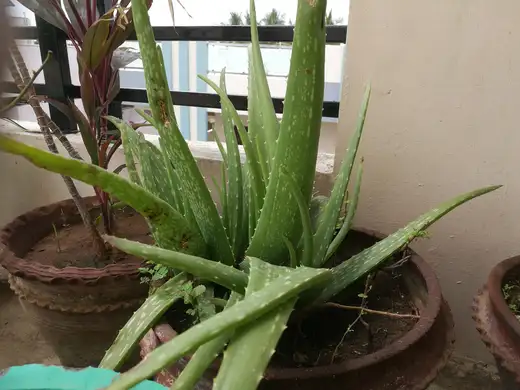

Aloe Vera Plants at a glance
- Botanical name
- Aloe vera
- Light
- full sun to partial shade outdoors; indoors a bright south- or west-facing window
- Hardiness zones
- 10-11
- Containers
- Yes
Aloe vera is a succulent. It stores water in thick leaves that grow in a rosette and can reach 18 inches long. It survives drought, poor soil and neglect. What it can’t survive is roots sitting in wet soil, especially in a cool room in winter. Almost every rule below follows from that one fact.
Indoors, a mature plant usually reaches 1 to 2 feet tall and about as wide. Over time it fills its pot with offsets, the small plants that sprout around the base. Kept small, it fits on a kitchen windowsill. Given a bigger pot, it gets bigger: UF/IFAS notes that the room you give the roots largely decides how large the plant grows.
Light: the brightest spot you have
Indoors, put aloe in a south- or west-facing window. Penn State and the University of Arizona both recommend a sunny window, from full sun to bright indirect light. Turn the pot now and then so the plant grows evenly instead of leaning toward the glass. If no window is bright enough, a grow light works well.
South Dakota State Extension prefers bright indirect light and warns that direct sun can burn the leaves. The two views fit together once you know how aloe adjusts. A plant that has been in strong light all along handles direct sun. A plant used to a dim room burns when it is suddenly put in full sun.
Too little light shows clearly. The plant stretches, the leaves get thin and weak, and they start to flop or droop instead of standing up from the center. The fix is more light, not more water or fertilizer.
Watering: when and how much
Aloe grows actively from early spring to early fall. From fall through winter it is semi-dormant. Water to match that cycle.
- Spring to early fall: soak the pot thoroughly, let the excess drain out the bottom, then wait. UF/IFAS says to water again when the top inch of soil is dry. NC State and South Dakota State say to let the soil dry out completely. Either way, a dry spell between waterings is the goal.
- Fall through winter: water much less. Penn State’s guideline is to keep the mix barely moist, just enough that the leaves don’t shrivel.
- Always: empty the saucer. Never leave the pot standing in water.
To check, push a finger an inch into the mix. When in doubt, wait a few days. Penn State’s advice for all succulents is to err on the side of underwatering.
You can tell which mistake you have made from the leaves. Thirsty leaves turn yellowish, shriveled and puckered, and they recover once the plant is watered. Overwatered plants have soft, mushy leaves and roots that rot in wet soil. Dryness is easy to fix. Root rot often isn’t.
Pot and potting mix
Choose the pot first. It needs large drainage holes. NC State says clay is best; an unglazed clay pot helps the mix dry out between waterings. A decorative pot without holes is a trap: water collects at the bottom where you can’t see it.
Use a bagged cactus and succulent mix, or make your own. Penn State’s recipe is one part potting soil, one part sand and one part perlite or lava rock. The University of Arizona suggests regular potting mix with extra perlite, granite grit or coarse sand added. The goal is a mix that drains fast and never stays soggy. South Dakota State points out that aloe naturally grows in poor, sandy soil, so a rich, peaty mix holds more water than it needs.
Temperature and humidity
South Dakota State gives 55 to 85°F as the range closest to aloe’s native climate, and most homes fall within it. Aloe is not frost tolerant.
Humidity is not a concern. Ordinary indoor air, even dry winter air, suits aloe fine, so skip misting and pebble trays.
Feeding
Aloe needs very little fertilizer. The University of Arizona recommends one light application of houseplant fertilizer in spring, and South Dakota State says most plants need none at all. If you do feed, use a diluted water-soluble fertilizer during active growth. University of Illinois Extension’s general houseplant guidance is March through September, never in winter. Illinois warns that fertilizer won’t make up for poor growing conditions and that too much can badly damage a plant.
Repotting
Penn State recommends repotting about every two years, which refreshes the mix and relieves crowded roots. Do it in spring, when growth starts again. Repot sooner if pups have crowded the pot.
- Ease the plant out and shake off the old mix.
- Choose a pot only slightly larger. Penn State suggests leaving 1 to 1.5 inches between the root ball and the pot wall. UF/IFAS warns against going more than two pot sizes up, because the extra soil stays wet and invites root rot.
- Set the plant so the lowest leaves sit just above the soil line, and fill in with fresh gritty mix.
Propagating from pups
Aloe vera spreads by underground runners that send up offsets, or pups, around the base. Dividing them is the easiest way to get new plants, and it is how most people share aloe with friends.
- Wait until a pup is a couple of inches tall. The University of Arizona uses that size as its guide.
- Unpot the clump if needed and cut the pup free with a clean, sharp knife. Keep whatever roots come with it.
- Leave the pup in a dry, shaded spot for about a week, until the cut surface dries and scabs over. This keeps rot organisms out of the wound.
- Pot it in succulent mix. Roots should form in about a month.
Aloe can be grown from seed, but it is slow and works best in a greenhouse, so home growers stick to pups. NC State notes that plants generally flower only once they are at least three years old.
Flowers
A mature aloe sends up a spike 2 to 3 feet tall with tubular yellow, orange or red flowers that open from the bottom up. Outdoor plants usually bloom in late winter or spring, and the flowers attract hummingbirds and bees. Indoor plants rarely bloom, so a plant that doesn’t flower indoors isn’t sick.
Growing aloe outdoors, region by region
Cold-winter areas (most of the country). Grow aloe as a houseplant and, if you like, set the pot outside for summer once nights stay at or above about 55°F, the low end of the range South Dakota State gives. Start it in partial light and move it into stronger sun gradually, or it will scorch. UF/IFAS also notes that a plant moved from bright summer sun back into a dim house can show some stress, so give it your sunniest window. Bring it inside before the first fall frost. The University of Arizona says before the first fall freeze, and Penn State says before the threat of frost. Your area’s first frost date is the deadline.
Florida and the Gulf Coast. UF/IFAS lists aloe for outdoor planting in zones 8 through 11 in Florida, a wider range than NC State’s zone 10 and warmer. Aloe is a Florida-Friendly Landscaping groundcover. Plant it in full sun and well-drained soil, water it until it is established, and after that it can usually get by on rainfall. UF/IFAS lists it as not a problem species in Florida’s natural areas. NC State rates it tolerant of salt, deer and drought, which helps in coastal gardens. Zone 8 and 9 parts of north Florida and the northern Gulf Coast still get freezes most winters, so protect in-ground plants on frost nights as described for the low desert below, or grow aloe in pots there. The main humid-climate risk is fungal disease: South Dakota State notes that rust and other fungal problems appear in cool, humid weather. Give plants full sun and air movement, and keep beds from staying soggy.
The low desert Southwest. The University of Arizona says aloe can grow outdoors only where there is no chance of freezing. In the low desert it blooms in spring. A University of Arizona Extension article defines a light frost as 29 to 32°F, and that is enough to seriously damage succulents. When frost is forecast, move potted aloes indoors or under a porch roof near a warm wall. Cover plants in the ground before dusk with frost cloth or a sheet that reaches the ground, so the soil’s daytime heat stays trapped. Use cloth, not plastic. If a freeze damages leaves, leave them alone until spring and cut them away once new growth appears.
Zones 10-11 and other frost-free areas (south Florida, Hawaii, frost-free coastal California): aloe can live in the ground year-round in full sun to partial shade. Give it soil that drains well, since a bed that stays wet in a rainy spell will rot the roots just as a soggy pot does.
Problems and fixes
- Soft, mushy, darkening leaves at the base: root rot from overwatering or a pot that doesn’t drain. South Dakota State notes that rot caught late is often fatal. Let the soil dry, and move the plant into fresh gritty mix in a pot with large drainage holes.
- Yellowish, shriveled, puckered leaves: thirst. If the soil is bone dry, soak it. South Dakota State says the plant should recover once watered.
- Pale, stretched, floppy growth: not enough light. Move the plant to a brighter window or add a grow light.
- Brown, reddish or bleached patches after a move outdoors: sunburn. Shade the plant, then move it into sun more gradually.
- White, cottony clusters at the base and sticky leaves: mealybugs. Their sticky honeydew can grow sooty mold. South Dakota State recommends insecticidal soap, used according to the label. Aloe scale and aloe mite are less common pests. Aphids also feed on aloe.
- Yellow spots that turn brown: aloe rust. South Dakota State says it usually doesn’t need treatment and is favored by cool temperatures and high humidity. NC State also lists leaf spot and sooty mold.
- Damaged, collapsed leaves after a cold night: frost or freeze damage. Bring potted plants inside before frost. For plants in the ground, wait for spring growth before pruning.
Using the gel, and safety
Aloe is famous for its gel. The University of Arizona calls it perhaps the most widely used medicinal plant in the world, and the plant may be most familiar as a first-aid treatment for minor burns. To use it, cut a mature leaf about 1 inch wide, slice it open and apply the clear gel to the skin. NC State suggests trimming away the green outer layer, using only the gel, and testing a small patch of skin first.
Just under the leaf skin is a bitter yellow latex, a different substance from the clear gel. NC State notes that the latex can irritate skin and, if eaten, can cause cramping and diarrhea. South Dakota State advises that neither people nor pets should eat the plant. The University of Arizona adds that medical research has not confirmed many of the claims made for aloe. Talk to a doctor before using it on anything more serious than a small cut, burn or insect bite.
For pets, ASPCA lists aloe as toxic to dogs, cats and horses. The plant contains saponins and anthraquinones, which can cause vomiting, lethargy and diarrhea. Keep the pot where cats can’t reach it.
Other aloes worth growing
Penn State counts more than 400 aloe species. If a full-size plant is too big for your window, Penn State suggests several smaller aloes for indoor growing:
- Lace aloe (Aloe aristata): white-dotted leaves, pink flowers.
- Coral aloe (Aloe striata): leaves edged in pink.
- Tiger tooth aloe (Aloe juvenna): leaves with soft teeth along the edges.
- Spider aloe (Aloe humilis): blue-green leaves that curl upward.
- ‘White Fox’: white leaves with dark splotches.
They need the same light, gritty mix and sparing water as aloe vera.
Questions
How often should I water aloe vera?
Go by the soil, not the calendar. During spring and summer, soak the pot once the top inch is dry (UF/IFAS) or the mix has dried completely (NC State), and let it drain. From fall through winter, water only enough to keep the leaves from shriveling.
Why are my aloe leaves soft and mushy?
Soft, mushy, darkening leaves usually mean the roots are rotting from too much water or poor drainage. Stop watering, check the roots, and move the plant into a gritty succulent mix in a pot with large drainage holes. Caught late, root rot can kill the plant.
Why is my aloe turning brown or reddish in the sun?
That is usually sunburn from moving a plant from dim indoor light into strong sun too quickly. Move it back into partial light, then move it into stronger sun gradually.
Can aloe vera live outside?
Year-round only where it doesn't freeze. NC State lists zones 10 and warmer, while UF/IFAS says zones 8-11 in Florida. Elsewhere, a potted aloe can spend summer outdoors but must come in before the first fall frost.
How do I separate aloe pups?
Wait until the offsets are a couple of inches tall, then cut them away from the mother plant with a clean, sharp knife. Let the cut dry for about a week before potting them in succulent mix. They root in about a month.
Is aloe vera toxic to cats and dogs?
Yes. ASPCA lists aloe as toxic to dogs, cats and horses. Eating the plant can cause vomiting, lethargy and diarrhea. Keep it where pets cannot chew it.
Sources
- Aloe Vera: Houseplant How-To · South Dakota State University Extension
- Winter is Coming (frost and freeze protection in the low desert) · University of Arizona Cooperative Extension
- Frost Protection (AZ1002) · University of Arizona Cooperative Extension
- Aloe vera (Aloe, Barbados Aloe, Medicinal Aloe) · North Carolina State Extension Gardener Plant Toolbox
- Aloe Vera · University of Florida IFAS Extension, Gardening Solutions
- Backyard Gardener #169: Aloe Vera · University of Arizona Cooperative Extension
- Aloe, a Hardy Houseplant · Penn State Extension
- One of the most popular houseplants - aloe - easy-going growing! · UF/IFAS Extension Charlotte County
- Aloe vera - Assessment of Non-Native Plants in Florida's Natural Areas · University of Florida IFAS
- Garden Tips: Houseplants (Knox County Master Gardeners) · University of Illinois Extension
- Toxic and Non-toxic Plants: Aloe · ASPCA Animal Poison Control