How to Grow Ornamental Alliums
Plant ornamental allium bulbs in fall, in full sun and well-drained soil. Large bulbs such as giant allium and 'Globemaster' go about 8 inches deep and a foot apart; small ones go 3 to 4 inches deep. They need almost no fertilizer, deer and rabbits leave them alone, and the globe-shaped flowers open from late spring into summer.

Your dates for ornamental alliums
Set your ZIP code at the top of the page and we will work out when to plant ornamental alliums where you live, from the frost records of the nearest NOAA weather station. Your ZIP code is remembered on this device only.
Ornamental Alliums at a glance
- Botanical name
- Allium spp. (e.g. A. giganteum, A. christophii, A. aflatunense, A. sphaerocephalon, 'Globemaster')
- Light
- full sun (6+ hours); many tolerate part sun, but shade gives floppy stems
- Frost tolerance
- Hardy: takes a hard frost
- Hardiness zones
- 4-8 for giant allium (A. giganteum); 4-9 for the genus as a whole (NC State Extension).
- Planting depth
- 8 inches
- Spacing
- 12 inches apart
When to plant ornamental alliums
| Zone | Fall planting |
|---|---|
| Zone 2a * | Jul 25 to Sep 19 |
| Zone 3a * | Aug 3 to Sep 28 |
| Zone 3b * | Aug 13 to Oct 8 |
| Zone 4a | Aug 17 to Oct 12 |
| Zone 4b | Aug 20 to Oct 15 |
| Zone 5a | Aug 23 to Oct 18 |
| Zone 5b | Aug 29 to Oct 24 |
| Zone 6a | Sep 5 to Oct 31 |
| Zone 6b | Sep 10 to Nov 5 |
| Zone 7a | Sep 13 to Nov 8 |
| Zone 7b | Sep 20 to Nov 15 |
| Zone 8a | Sep 26 to Nov 21 |
| Zone 8b | Oct 2 to Nov 27 |
| Zone 9a * | Oct 15 to Dec 10 |
| Zone 9b * | Oct 28 to Dec 23 |
* Outside zones 4 to 8, the hardiness range our sources give for ornamental alliums. Plants there may not survive the winter or get enough winter chill, and are usually grown as annuals or in pots.
When to plant ornamental alliums
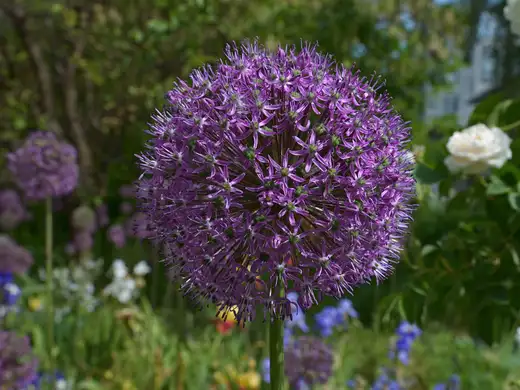
Ornamental alliums are onions grown for their flowers. The genus has roughly 700 species, including garlic, chives and shallots, but the garden types carry their small flowers in round heads that range from the size of a quarter to the size of a volleyball. Depending on species they flower from late spring into midsummer; Rutgers counts them among the last of the spring bulbs, still blooming in late May.
Types worth knowing
Iowa State Extension describes these, and most are widely sold:
- Giant allium (A. giganteum). Pale purple, softball-size heads on 40-inch stems in late spring. NC State notes it can reach 6 feet. Its leaves start fading as it flowers.
- ‘Globemaster’. A hybrid of A. christophii and A. macleanii bred in Holland as a cut flower. Iowa State calls it one of the most reliable alliums, with softball- to volleyball-size pinkish-purple heads on 24- to 36-inch stems in early summer.
- ‘Purple Sensation’ (A. aflatunense). Baseball-size violet heads on 20- to 30-inch stems.
- Star of Persia (A. christophii). Loose amethyst heads 10 to 12 inches across on 12- to 20-inch stems. They last two to three weeks and dry silvery-tan in place.
- A. schubertii. Open heads like exploding fireworks, approaching volleyball size, on 12- to 24-inch stems.
- A. karataviense. One of the shortest, with broad gray-blue leaves and golf-ball heads on 8- to 12-inch stems.
- Drumstick allium (A. sphaerocephalon). Quarter-size heads, maroon at the base fading to purple at the top, in early summer. It reseeds into small colonies.
- ‘Millenium’ and similar hybrids. Clump-forming plants with 2-inch lavender heads in mid- to late summer and glossy leaves that stay green all season, unlike the bulb types.
For the South, Clemson recommends Naples onion (A. neapolitanum), drumstick allium, A. oreophilum and star of Persia, all late-spring bloomers. Around Austin, Travis County Master Gardeners grow the Texas native A. drummondii and rosy garlic (A. roseum), but warn that both reseed aggressively.
Where to plant
Alliums flower best in full sun, ideally six hours or more. Many tolerate part sun, but Iowa State finds that shade produces floppy stems. They want soil that is moist during growth but drains well. Bulbs rot in soggy ground, and overly damp sites also bring fungal problems. Once growth ends they tolerate summer drought.
Put tall types toward the back of a border. NC State plants giant allium in groups of five to nine and pairs it with daylilies and low ornamental grasses. This is a design choice: the neighbors’ foliage hides the allium leaves, which yellow early.
How deep to plant allium bulbs
Plant dry bulbs in fall. Iowa State suggests October; South Dakota State finds alliums less fussy about timing than most bulbs and plants them up to a few weeks before a hard frost. Until then, keep bulbs cool and dark. The dates for your zone above show the window.
Depth depends on bulb size:
- Large bulbs (giant allium, ‘Globemaster’, ‘Purple Sensation’): 6 to 8 inches deep. NC State uses 8 inches deep and 12 inches apart for giant allium, about one bulb per square foot. Nebraska gives 6 inches deep and 12 apart.
- Small bulbs (drumstick, A. moly, A. oreophilum): 3 to 4 inches deep (Iowa State). Colorado State gives 2 to 4 inches. Nebraska lists other allium species at 6 inches deep and 6 to 12 inches apart.
Set the pointed end up, cover, and water in. Colorado State recommends mulching bulbs left in the ground each fall.
Care through the year
Alliums need little. Fertilizer is usually unnecessary; if a soil test shows a need, Iowa State suggests a light all-purpose feeding in early spring as the leaves emerge, every few years at most. Keep soil moist while plants are growing. The tallest stems may need staking.
After bloom, leave the leaves until they are completely brown so the bulb can store food. On large-bulb species the foliage often yellows before or while the flowers open.
The dried heads of the big globe types stay attractive for weeks and make good dried flowers. Deadhead the reseeding types as soon as the flowers fade. Iowa State names drumstick allium, A. caeruleum, A. moly and nodding onion (A. cernuum) as free seeders.
Dividing and propagating
Large-bulb alliums form offsets that can be separated in fall and replanted. Clump-forming types such as ‘Millenium’ are easy to divide in early spring or early fall. Alliums also grow from seed, but many need alternating warm and cold periods to germinate, and Iowa State says seedlings take about three years to reach blooming size.
Problems
- Bulb rot, white rot and black rot. All are favored by wet soil. Improve drainage or choose another site.
- Rust and mildew. Damp, crowded conditions. Give plants air.
- Bulb mites. Discard soft or damaged bulbs.
- Unwanted seedlings. Deadhead reseeding species promptly.
- Ugly foliage at bloom time. Normal for large species. Hide it with neighboring plants rather than cutting it green.
Deer, rabbits and rodents rarely bother alliums, because every part smells of onion when crushed.
Questions
Why are my allium leaves turning yellow before the flowers open?
That's normal for many large-bulb alliums, including giant allium and star of Persia. The leaves start dying back as the plant flowers. Leave them until they are fully brown and hide them with neighboring perennials.
Should I deadhead alliums?
Only the types that reseed heavily, such as drumstick allium, blue globe onion (A. caeruleum), golden garlic (A. moly) and nodding onion. Cut them as soon as the flowers fade. The big globe types dry well on the stem and can be left for their seed heads.
Do deer and rabbits eat alliums?
Rarely. Crushed leaves and flowers smell of onion, which keeps deer, rabbits and rodents away.
Can I plant alliums in spring?
Dry bulbs should go in during fall. Alliums sold growing in nursery pots can be planted in spring or early fall like other perennials, Iowa State says.
Do alliums grow in the South?
Some do. Clemson recommends Naples onion, drumstick allium, A. oreophilum and star of Persia for South Carolina. Plant them where water never stands, because damp soil leads to bulb rot.
Sources
- Spring Flowering Bulbs (G1742) · University of Nebraska-Lincoln Extension
- All About Ornamental Onions · Iowa State University Extension and Outreach
- Allium giganteum - North Carolina Extension Gardener Plant Toolbox · NC State Extension
- Allium (Onion, Ornamental Onions) - North Carolina Extension Gardener Plant Toolbox · NC State Extension
- Bulbs: Alliums (PlantTalk Colorado 1006) · Colorado State University Extension
- Bulbs to Plant in the Fall · South Dakota State University Extension
- Spring-Flowering Bulbs (HGIC) · Clemson Cooperative Extension Home & Garden Information Center
- Bulbs for Central Texas · Texas A&M AgriLife Extension, Travis County
- Spring Flowering Bulbs (FS1220) · Rutgers Cooperative Extension
- Plant Bulbs in the Fall for a Spring Celebration · Penn State Extension
- Bulbs (Backyard Farmer) · University of Nebraska-Lincoln Extension, Backyard Farmer
- How to plant flower bulbs for a colorful spring display · University of Illinois Extension